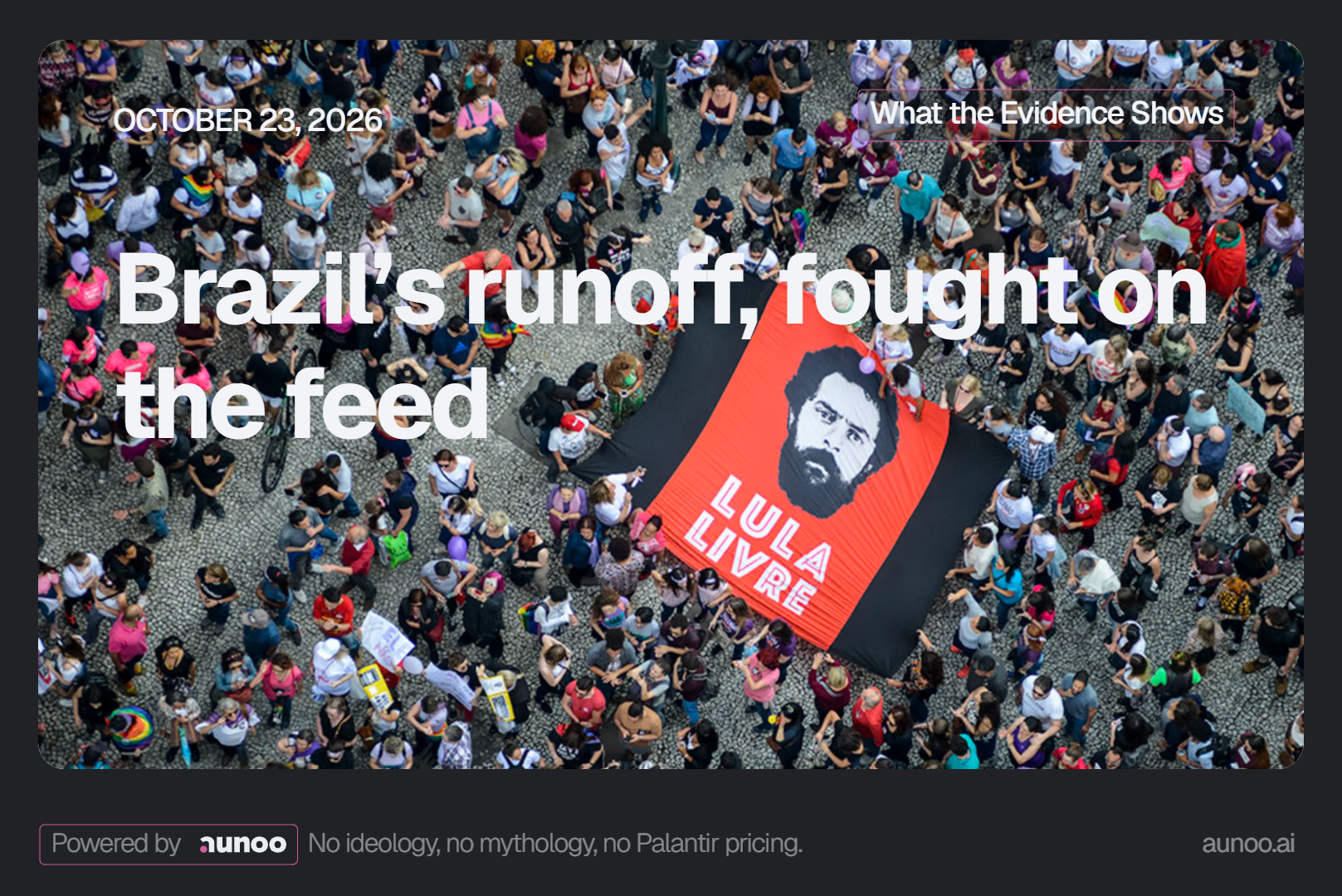
Three days before Brazil’s 25 October runoff, President Luiz Inácio Lula da Silva and Senator Flávio Bolsonaro are in a statistical tie, and much of the fight has moved to social media, the courts and claims of foreign interference. Bolsonaro won the 4 October first round by about 47% to 45% (AP via Yakima Herald). Datafolha’s 15 October poll put him on 51% of valid votes to Lula’s 49%, within the margin of error (Economic Times/AFP).
The senator is the eldest son of former president Jair Bolsonaro, who is serving a 27-year sentence for plotting a coup after his 2022 defeat (AP). Lula, 80, is seeking a fourth, non-consecutive term. Disinformation, Big Tech and outside pressure have shaped the race, and supporters on both sides describe the stakes as existential.
The Meta dispute: real problems, unproven motive
Meta’s platforms restricted the reach of Lula’s accounts at key moments of the campaign, though no court has found that it was deliberate. After the first round, Lula’s campaign said his Instagram profile could not boost posts, view counts froze, and leftist profiles briefly dropped out of search (France 24). For almost 24 hours Lula could not boost posts while Bolsonaro could (The Guardian).
Folha de S.Paulo reported internal Meta messages in which staff acknowledged the restrictions hurt Lula’s accounts and noted the platform was recommending Bolsonaro’s profile and WhatsApp channel (Al Jazeera). On 15 October, electoral court justice Marco Aurélio Bellizze ordered Meta to treat both candidates equally, including in its Meta AI chatbot, under threat of daily fines (AP via CTV).
Meta denies any bias. It says one glitch froze Reels view counts in more than 100 countries and another briefly broke ad creation, and that a Meta AI loophole affected image generation for Lula for a day longer than for Bolsonaro (AP via CTV). Bellizze said he had found no evidence of deliberate action, but twice gave Meta 24 hours to prove the problems were fixed (The Guardian). Meta’s own oversight board said it was concerned by recurring failures in its election-integrity work.
Both camps are now using platforms in court. Lula’s team is seeking Bolsonaro’s disqualification over alleged “algorithmic manipulation”, while Bolsonaro’s team wants Lula barred for mass government messaging on WhatsApp (Al Jazeera).
Foreign influence: open US pressure, endorsements from Netanyahu and Milei
Washington has put open pressure on Brazil during the campaign, though it denies interfering in the vote. The Trump administration imposed tariffs on Brazilian goods and designated Brazil’s two biggest gangs, the PCC and Comando Vermelho, as terrorist organisations. Brazilian officials suspect this is partly meant to make Lula look soft on crime (The Guardian). In July, Brazil refused visas to two State Department officials it said planned to cast doubt on its voting system; the US denied that (AP).
Brazil’s attorney general has opened a probe into reports that the US planned to send $1 million to civil-society groups opposed to Brazil’s Supreme Court (Euronews). Trump has openly backed Bolsonaro, who met him at the White House in May (Irish Times). Lula’s campaign ran an ad accusing Trump of wanting to “colonise” Brazil for its resources, and the State Department denied meddling (The Guardian).
Other foreign leaders have taken sides in public. Israeli Prime Minister Benjamin Netanyahu recorded a video supporting Bolsonaro, and Argentina’s Javier Milei spoke at his party’s convention (AP).
Disinformation runs in both directions
False content in this campaign has not come from one side only. The biggest religious rumour of the race targeted Bolsonaro: posts claimed he planned to strip Our Lady of Aparecida of her title as Brazil’s patron saint. The claim traced back to a 2007 bill he had nothing to do with, which was shelved the following year (Diário do Grande ABC). GloboNews issued a retraction, and a TSE judge ordered 1,125 posts removed before a Supreme Court justice reversed that order on free-speech grounds (Diário do Grande ABC).
On the pro-Lula side, a WhatsApp channel called “Exército do Lula” (Lula’s Army), run by congressman André Janones, passed 4 million followers after the first round. TSE president Kassio Nunes Marques suspended it, citing instructions to share content without checking it first, then allowed it back once the campaign registered it as official propaganda (Congresso em Foco). Reported membership was about 4.3 million in mid-October.
A third strand is plain fraud. Estado de Minas found a network of AI-generated female profiles posing as supporters of both candidates, mostly Bolsonaro, to lure men towards paid sexual content (Estado de Minas). Lula’s campaign has also asked why 255 accounts it calls AI-run and inauthentic remain active (Irish Times).
Faith on the campaign trail
Religion is splitting the vote clearly, and tension with the Catholic Church is on the record. A Datafolha poll from 1 October gave Bolsonaro 52% among evangelicals to Lula’s 26%, while Lula led Catholics 50% to 32% (Diário do Grande ABC). Bolsonaro, who identifies as evangelical, accused people inside the Catholic bishops’ conference (CNBB) of helping the PT spread the Aparecida rumour. The federal attorney general, Jorge Messias, said the CNBB had been unfairly attacked (Diário do Grande ABC).
The Diocese of Santo André was accused online of ideological bias after sharing a CNBB message calling for a peaceful election (Diário do Grande ABC). The CNBB says it endorses no candidate or party. Evangelical politicians themselves span left, centre and right.
The betting crackdown
Lula has made online gambling a central campaign issue, and the industry is pushing back. He called betting a disease, promised to “end the bets”, and on 25 September was expected to announce a provisional measure against the platforms, nine days before the first round (Jornal Opção). Industry groups began lobbying Congress against it, and an AtlasIntel poll found 75% of Brazilians oppose the betting sites (A Tarde).
Two caveats complicate the story. Betting was legalised under Michel Temer in 2018 but regulated and taxed under Lula in 2023, which his opponents point out. Bolsonaro also proposes curbs, such as barring welfare money from being used for bets (BNLData). Football clubs, 14 of 20 of which in the top division carry betting sponsors, are among the interests most exposed (BNLData).
Investigations on both sides
Bolsonaro goes into the runoff under federal police investigation, authorised by the Supreme Court, for alleged money laundering and corruption tied to funding from banker Daniel Vorcaro of the collapsed Banco Master for Dark Horse, a film about his father. He denies wrongdoing (Al Jazeera; Brasil de Fato).
His past links to Rio’s militias are documented. As a state lawmaker he proposed an honour for Adriano da Nóbrega, a former police officer prosecutors named as a militia leader, and employed Nóbrega’s mother and wife (Diário do Centro do Mundo). However, investigators said they had no reason to link the Bolsonaros to the murder of councilwoman Marielle Franco, and he denies militia ties (AFP via Yahoo).
A rape allegation against his running mate, congressman Alfredo Gaspar, was shelved by Supreme Court justice Gilmar Mendes on 6 October without an inquiry being opened (Brasil de Fato). Gaspar denies it and gave a DNA sample. The electoral court has since ordered PT branches to delete a post presenting him as under investigation (CNN Brasil).
Lula’s side faces questions too. One son is under investigation for allegedly helping a businessman gain access to the government, and another over links to a businessman detained in a pension-fraud probe. Both deny wrongdoing (Al Jazeera). Lula’s own earlier corruption convictions were annulled. Both candidates have now offered to release bank, tax and phone records.
Minerals, sovereignty and what Sunday decides
Control of Brazil’s critical minerals has become a sovereignty issue in the campaign. Brazil holds the world’s second-largest rare-earth reserves. A US-backed firm, USA Rare Earth, agreed to buy Serra Verde, the country’s only commercial producer, for about $2.8 billion (AP). Lula called the deal, signed with an opposition state governor, a disgrace (TASS). He has pledged that no foreign power will touch the minerals without respecting Brazil’s sovereignty (Al Jazeera).
The environmental record will also be on the ballot. Amazon deforestation in the year to July 2026 fell to 3,335 sq km, the lowest since records began in 1988 (TBS News/AFP). Bolsonaro promises a “Bolsonaro 2.0” government, spending cuts modelled on Argentina’s Milei and closer ties to Washington (Bangkok Post/AFP). His supporters see him as a fix for crime and the cost of living. Whoever wins takes office on 5 January 2027.
This article was fact-checked using Aunoo AI.
Sources
Researched through Aunoo’s news corpus, 22 October 2026.
- AP: Lula launches reelection bid as concerns rise over foreign interference
- AP: Brazil heads to a runoff (via Yakima Herald)
- AP: Brazil’s Senate passes rare earth minerals regulation
- AP via CTV: Lula wins electoral court challenge against Meta
- AP via CTV: Meta denies accusation of anti-Lula bias
- The Guardian: Battle over Meta’s alleged Bolsonaro bias intensifies
- The Guardian: Echoes of cold war as US accused of meddling
- The Guardian: Lula says Trump wants to colonise Brazil
- Al Jazeera: Meta employees say Lula’s accounts restricted
- Al Jazeera: Lula, Bolsonaro seek to disqualify each other
- Al Jazeera: Bolsonaro challenges Lula to expand release of records
- Al Jazeera: Lula launches fourth-term bid
- France 24: Lula accuses Meta of election interference
- Economic Times/AFP: Lula closes gap ahead of runoff
- Euronews: Brazil probes alleged US plan to fund far-right causes
- Irish Times: Brazilians protest outside Meta in Dublin
- TBS News/AFP: Amazon deforestation hits four-decade low
- Bangkok Post/AFP: Prospect of Bolsonaro win looms over Indigenous
- TASS: Lula calls Serra Verde sale a disgrace
- AFP via Yahoo: Bolsonaro and son blast probe of hit man
- Brasil de Fato: Flávio Bolsonaro under PF investigation
- Brasil de Fato: Allegation against running mate shelved
- CNN Brasil: TSE orders PT to delete post on running mate
- Diário do Centro do Mundo: Flávio Bolsonaro and the militias
- Congresso em Foco: PT registers Exército do Lula with TSE
- Diário do Grande ABC: Bolsonaro’s last rally outside a church
- Diário do Grande ABC: Messias rejects Bolsonaro’s CNBB remarks
- Diário do Grande ABC: Diocese attacked after preaching peace
- Estado de Minas: AI women in politics scam
- Jornal Opção: Lula to announce betting ban
- A Tarde: Betting firms prepare counterattack
- BNLData: Bets become a central campaign issue
- BNLData: Why banning bets could cost Lula